Biographical Background
Dolma Lhakang is a monastic community in the eastern part of the Tibetan plateau on the Tsawa Gang range, which pre-1959 comprised some five hundred monks, nuns and yogis located in a series of sites, many of them closed retreats. On various occasions, in private and in public, Akong Rinpoché stated that his association with Dolma Lhakang had already endured some three centuries. This takes us back to the initial development of Dolma Lhakang on a pilgrimage site frequented by meditators since the twelfth century and he doubtless identified himself with the founders of that temple and institution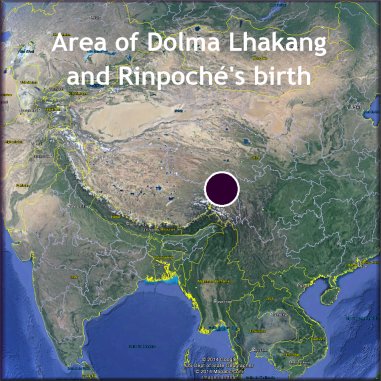 |
A rather hermetic “long-life prayer” (zhabs rten) written for the first Akong, Karma Miyo, by the Xth Trungpa incarnation, describes briefly the hundred former lives of Karma Miyo and takes us back to him as the very founder of dharma in Tibet in the seventh century, King Tsongtsen Gampo, and even prior to that. Dolma Lhakang was first and foremost a contemplative community, content to be led by whomever was manifestly the most spiritually-accomplished person at the time. There had never been a wish to have a “tulku”, due to the many complications that often involved within the Tibetan system. |
Akong Rinpoché was to become the exception to this, through his great destiny, as foreseen by several great minds in Tibet, not least that of the Gyalwang Karmapa. “He was born amid many marvellous signs in the Metal Dragon year of the 16th cycle (1940) in the Riwoche region of Tibet, in the hamlet of Darak. His father was Tashi Rinchen and his mother Kalu Dondrup Chuji. His Holiness Karmapa, Rangjung Rikpi Dorje, recognised him as the reincarnation of Lama Köncho or Akön Rinpoché, Karma Miyo, the former Abbot of the Dolma Lhakang monastery in the southern mountain range known as Tsawa Gang and he was enthroned. His tulku name is Karma Shedrup Chöki Nyima Tinley Kunchap Pal Zangpo Choley Nampar Gyalway Dey—"Sun of Dharma, All-EncompassingActivity, Good and Excellent, Completely Victorious Over All Things".”
The above is an extract from a brief biography drawn up in Tibet by Dolma Lhakang members. Among the “marvellous signs” were the water in the tent turning to milk when he was born and flowers blossoming although it was long before the season . The monastery elders, reluctant to enter into a “tulku” situation and responsibility, at first refused to look for one but ceded under pressure from Ka-Sé Kongtrul and the abbot of the monastery in Riwoché. The story goes that they incurred the Gyalwang Karmapa’s wrath when, feeling that he had chosen the child from a list of names in a very rapid and light way, they conferred outside the interview room and returned to ask if he was absolutely certain. Akong Rinpoché’s own account of this incident was that as they were approaching the Karmapa, the list in hand, he said “I already told you”, pointed to the list and a small hole apeared next to the name of the boy he had chosen. In Rinpoché’s own words, “When I was three [1] years old , I was recognised or chosen, and had to go to the monastery in order to be enthroned. Then I went back home for three years, and when I was six I went back to the monastery for my education. So from the age of six I was like an orphan because I grew up in a monastery.”
[1] The ages here are expressed in Tibetan terms, i.e. more or less from conception, and are a year more than their Western equivalents. He went to his monastery at the age of five therefore.
continue to next episode: education and instatement