Education & Instatement
From Akong Rinpoché's biography, written by his elders in Tibet:
“His learning to read, write and recite the traditional prayers was effortless, like that of an enlightened being. From the 11th Surmang Trungpa, Chöji Gyaltsen, he received the rin.chen.gter.mdzod series of empowerments and from Mahasiddha Karma Norbu he received the scriptural transmission (lung) of the Buddhist canon, the rin.chen.gter.mdzod and the collected works of Mipam Rinpoché (mi.pham.bka'.'bum). From Secchen Kongtrul Rinpoché, Pema Drimey,
he received
the empowerments and scriptural transmission 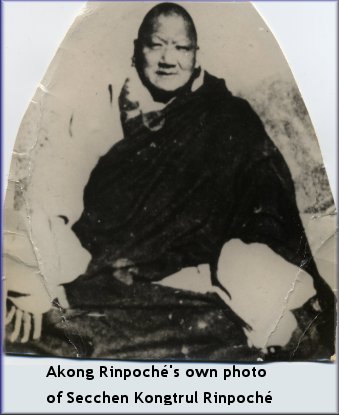 of the Complete Treasury of Vajrayana Quintessential Instruction (gdams.ngag.mdzod) and received instruction on the Compendium of Knowledge (shes.bya.mdzod)
and the Ocean of Mahamudra Definitive Meaning (nges.don. rgya.mtsho) [1] . From Surmang Rolpi Dorje he received the empowerments, scriptural transmission and instructions in the principal practices
(Vajravarahi, Chakrasamvara and Jinamarga etc.) of the three-year retreat practices, as well as the Oral Transmission of the Surmang line and of the former Rolpi Dorje.
When Karmapa Rangjung Rikpi Dorje was on his return journey from China, he gave Akong Rinpoché sramanera ordination vows, the bodhisattva vow and rare transmission of the protector practices. From Delgo Chentse Rinpoché he received the life-power instructions from the terma tradition. From Situ Rinpoché he received the empowerments of the Complete Treasury of Vajrayana Quintessential Instruction (gdams.ngag.mdzod) and from Gangshar Khenpo he received instructions on the Surhllekha (Nagarjuna's 'Letter to a Friend'), the Three Levels of Vow, Mipham's Treasury of Knowledge (mkhas.'jug), the Bodhicaryavatara and other works.”
In Rinpoché’s own words, “You don’t see your parents and you are brought up by monks in order to learn how to take care of the spiritual side of the monastery, also how to take care of the welfare of the monastery, and how to receive or give teachings for your community. There is much to learn from morning until night, seven days a week. And the responsibility is not just spiritual. Each monastery has its own territory and its own people. My responsibility was therefore not only
to my monastery but also the welfare of the whole community. My responsibility was to whoever wanted to receive instructions, to whoever had spiritual, family or land problems: any problems big or small, about health, sickness or death. The Tulku has the responsibility and makes the final decision. You make decisions about the monasteries, you make decisions about families, you even make decisions about shopping!
Tibetan shopping is done only once a year and takes about three months because it’s not about money but the exchange of goods between nomadic people and agricultural people. So you have to decide when they should go and which area they should go to. You have a lot of responsibility and every family thinks that you know all the answers. So they will come to you if they are sick or if somebody is dying, asking you to make sure they are born into a better life. It’s quite a hard life; the life of a Tulku is not
very easy. The Tulku's education starts at six in the morning and finishes at roughly nine o’clock in the evening. That’s our way of educating: not for five days, not for six days, but seven days a week. So from six to fourteen years old, for most of the time I studied, and for forty years my duty has been to make decisions about peoples' lives. And not just one person’s life, but you have the responsibility for thousands of peoples’ lives.
My job is to try to make sure that I don’t make mistakes, by learning things properly. I’m sure that I have made mistakes, but not intentionally. I have done the best I can. Then when I was fifteen I went to universities, and then from eighteen or nineteen I travelled around different parts of Tibet to receive teachings from well known teachers.” [2]
While still in Tibet, Rinpoché did manage some months solitary retreat: one of them notably after having been lowered into a Guru Rinpoché cave situated on the mountain near Dolma Lhakang.
Predictions and Ordination
Akong Rinpoché mentioned on several occasions predictions that were made while he was still young and in Tibet. One came from his own teachers in Dolma Lhakang on advice from an eminent nearby lama—Jédrung Rinpoché from the Riwoché monastery—advising him against taking the full monastic vows (Gélong) as these may prove an obstacle in his later life. He already had received the novice vows (Gényen). Rinpoché explained this as foreseeing his lay life and family later on. It would be easier to ‘give back’ the novice vows than the full ordination.
Another prediction that Rinpoché took quite seriously came from a lama in eastern Tibet who was famous for seeing the future through palm-reading. He predicted that Rinpoché’s life would only come into its full at the age of forty and that after the age of sixty he would move into fame. That was indeed the case.
[1] This text, the Ocean of Mahamudra Definitive Meaning, was to become a profound influence on Akong Rinpoché's life
[2] Rinpoché's own quotes here come from a transcript of a recording I made of Akong Rinpoché in Zimbabwe in 2006 (author: Ken Holmes)
continue to next episode: the flight into exile